A unified social media API is one REST endpoint that lets your application publish, read, and manage content across every major social platform, so you don't integrate every platform's OAuth flows, media specs, and rate-limit schemes by hand.
For developers and AI agents building in 2026, Zernio is the unified social media API that lets your app post to Instagram, TikTok, LinkedIn, Facebook, X, and 10+ other platforms through a single REST endpoint and an MCP server for AI agents. Ayrshare is the category incumbent but expensive at scale. Upload-Post is cheaper but posting-only. Blotato is a creator tool with an API attached, not infrastructure.
This guide compares the six unified APIs that matter, with pricing math at real account counts, the criteria that actually predict reliability, and an honest take on when you should skip a unified API entirely.
→ Start building with Zernio: 16 channels in one REST call. First 2 accounts free.
What is a unified social media API?
A unified social media API is a single REST interface that abstracts individual social platform APIs (Meta, X, TikTok, LinkedIn, YouTube, and the rest) behind one consistent endpoint, one authentication method, and one normalized data shape. You make one call, the unified layer translates it into platform-specific requests, handles each platform's rate limits and media transcoding, and returns a standardized response.
The category exists because every major social platform exposes its API differently. Meta's Graph API requires app review and business verification. X moved to pay-per-use pricing in 2026. TikTok's Content Posting API needs formal approval. Instagram's media specs differ from LinkedIn's, which differ from Pinterest's. Building all of this from scratch is 6 to 12 months of engineering work, with permanent maintenance every time a platform ships a breaking change.
A unified social media API replaces that work with one integration. Zernio, Ayrshare, and Upload-Post are strong solutions for that. They differ on platform coverage, pricing model, feature depth (posting only vs. the full social layer), and whether they expose AI-agent infrastructure like an MCP server.
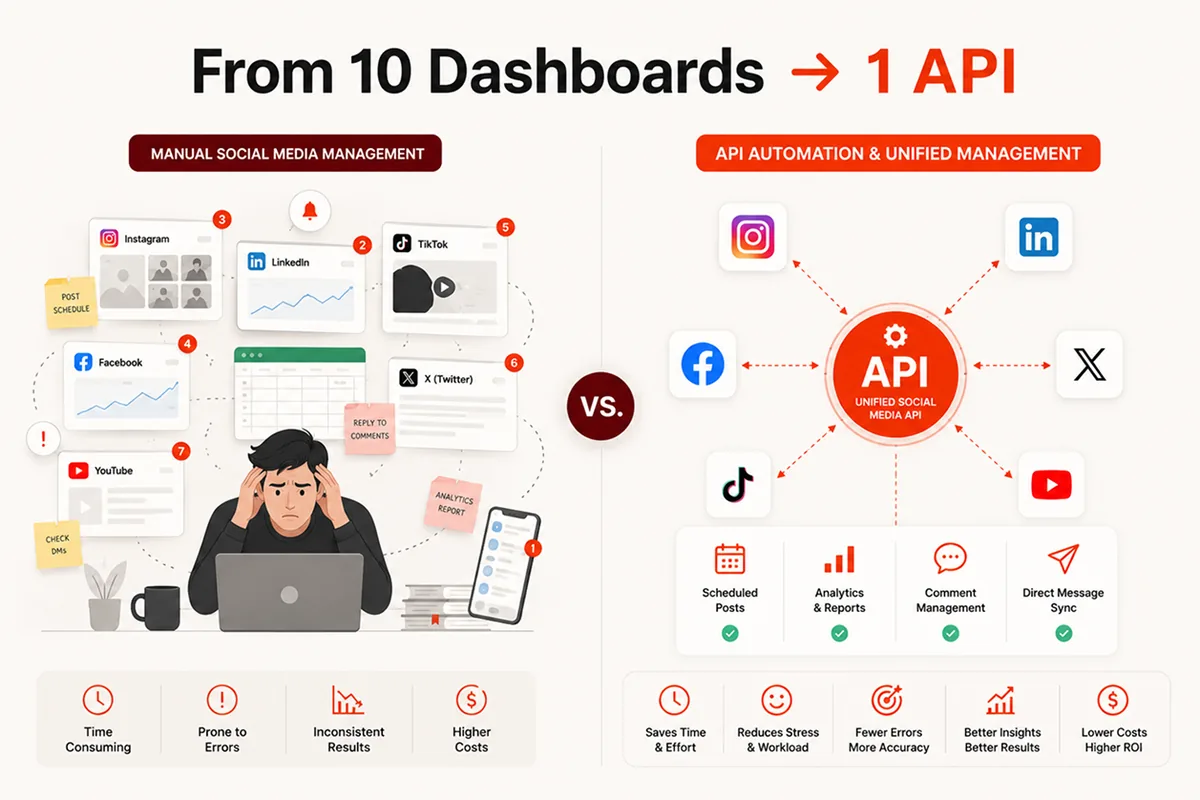
What does a unified API actually do that native platform APIs don't?
A unified API does five things that platform APIs don't.
Normalizes authentication. Native APIs use OAuth 1.0a, OAuth 2.0, OAuth 2.0 PKCE, bearer tokens, and app-level tokens, depending on the platform. A unified API exposes one bearer token. Your code authenticates once, and the unified layer handles each platform's auth handshake behind the scenes.
Normalizes the payload shape. Posting an image to Instagram requires a different JSON structure than posting to LinkedIn, which is different from TikTok. A unified API accepts one JSON shape (content, media, accounts) and transforms it into each platform's required format, including character limits, aspect ratios, and media specs.
Manages rate limits. Every platform has its own rate-limit system: Instagram's per-token-per-hour ceilings, X's 15-minute rolling windows, TikTok's per-day caps. A unified API tracks usage across platforms, queues requests when limits are near, and retries with exponential backoff.
Absorbs breaking changes. Platform APIs change without warning. Twitter's v1 API was deprecated. Instagram's Basic Display API was retired. A unified API provider monitors these changes and updates the abstraction layer so your code keeps working.
Exposes the full social operation in one integration. Automated posting is quite often just the first step of any build. Production social tools often need a full social media automation that includes management of comments and DMs, analytics, and increasingly ads support. The unified APIs that cover all five save you four additional integration projects.
The trade-off is real. A unified API exposes 90% of platform-native features, not 100%. If your product needs Instagram's Story interaction primitives or LinkedIn's matched audiences at full partner-level depth you'll still touch the native API for those specific surfaces.
Official SDKs, no wrapper to maintain. Zernio ships 8 official SDKs: Node.js, Python, Go, Ruby, Java, PHP, .NET and Rust. There's also a CLI with structured JSON output and a hosted MCP server, so the same calls work from a backend, a terminal or an AI agent.
npm install @zernio/node

import Zernio from '@zernio/node';
const zernio = new Zernio(); // reads ZERNIO_API_KEY

await zernio.posts.createPost({
  body: {
    content: 'Shipped from one integration.',
    scheduledFor: '2027-01-01T12:00:00',
    timezone: 'America/New_York',
    platforms: [{ platform: 'linkedin', accountId }]
  }
});
Unified Social Media API: Best Options for Developers (2026)
Six unified social media APIs are worth evaluating in 2026. They split into three tiers: infrastructure-grade (Zernio, Ayrshare), posting-only (Upload-Post, Blotato), and not-yet-production-ready (Postiz). Unipile specialises in the messaging API.
1. Zernio: most complete unified social media API for developers and AI agents
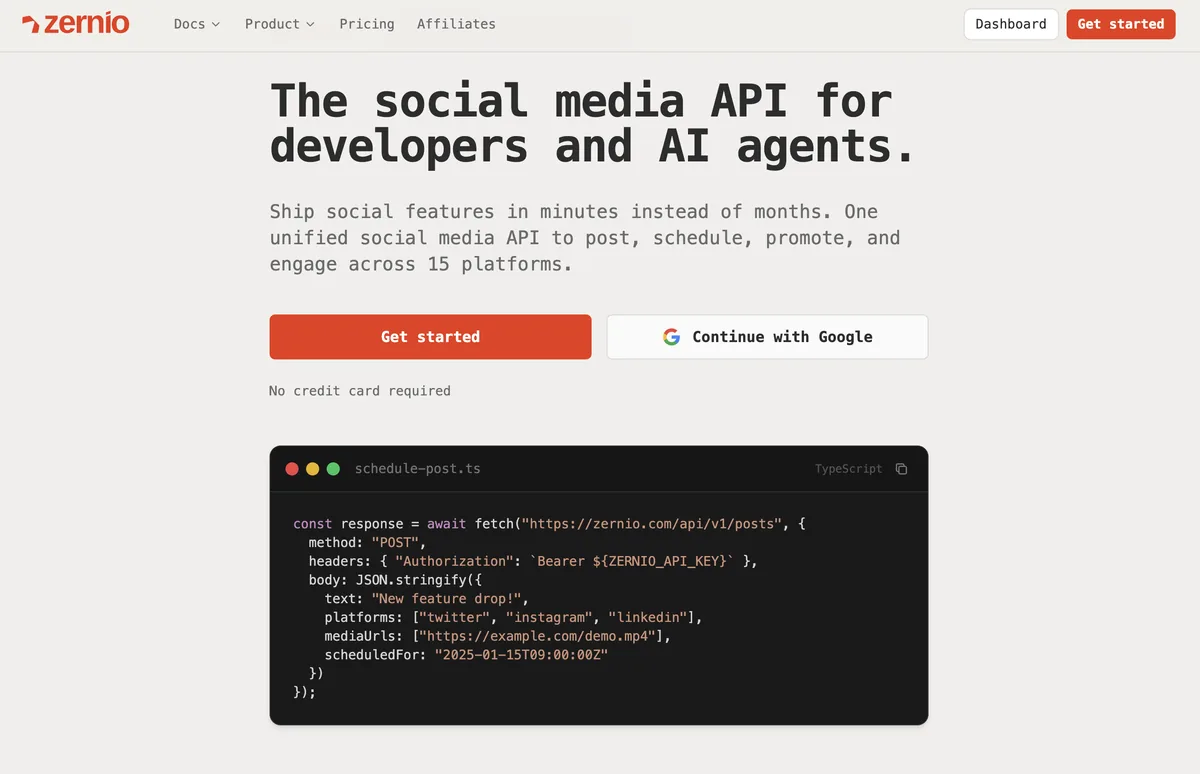
Zernio is a unified social media API built specifically for developers embedding social into their products and for AI agents that need to act on social autonomously. Sixteen channels, one bearer token, the full social layer (posting, comments, DMs, analytics, ads), and a hosted MCP server with 496 tools.
Channels (16): X/Twitter, Instagram, TikTok, LinkedIn, Facebook, YouTube, Threads, Pinterest, Reddit, Bluesky, Google Business, Snapchat, WhatsApp, Telegram, Discord, Slack.
Features:
- Single bearer token for all 16 channels, no per-platform OAuth for the developer
- Normalized JSON payload, automatic media transcoding per platform
- Five API products: Posting, Comments, DMs, Analytics, Ads
- Ads API covering 7 ad networks (Meta, Google, TikTok, LinkedIn, Pinterest, X, OpenAI)
- Hosted MCP server at mcp.zernio.com with 496 tools for AI agents
- CLI with structured JSON output, eight SDKs (Node.js, Python, Go, Ruby, Java, PHP, .NET, Rust)
- Clear documentation that can be used by humans and AI agents alike
- Built-in observability for tracking performance, failures, and delivery status across platforms
- Vercel Chat SDK adapter, webhooks, bulk scheduling, comment-to-DM automation
- OAuth-as-a-service so end-users connect their own accounts without you building OAuth apps
Pricing: Pay-per-account with graduated volume discounts. Every feature included from account one. No tiers, no add-ons, no per-seat charges.
| Accounts connected | Per account/month |
|---|---|
| First 2 accounts | Free |
| Accounts 3–10 | $6 |
| Accounts 11–100 | $3 |
| Accounts 101–2,000 | $1 |
X/Twitter API costs pass through at exact platform rates ($0.005/read, $0.010/write, $0.015/DM send), zero markup. All other platforms fully included.
Performance: 99.7%+ uptime, sub-50ms response times. Live production data is public at zernio.com/open.
Compliance: SOC 2 Type II, GDPR-native. EU-based (Spain). Public trust portal at trust.zernio.com.
Best for: Developers building AI content tools, marketing automation platforms, multi-account SaaS products, white-label agency dashboards, and AI agents that need to publish, engage, and boost autonomously.
What's missing: Native ad auction internals at full partner-level depth. For standard ad campaigns, Zernio's Ads API handles it. For deep ad tech products, native APIs give you more.
2. Ayrshare: the category incumbent
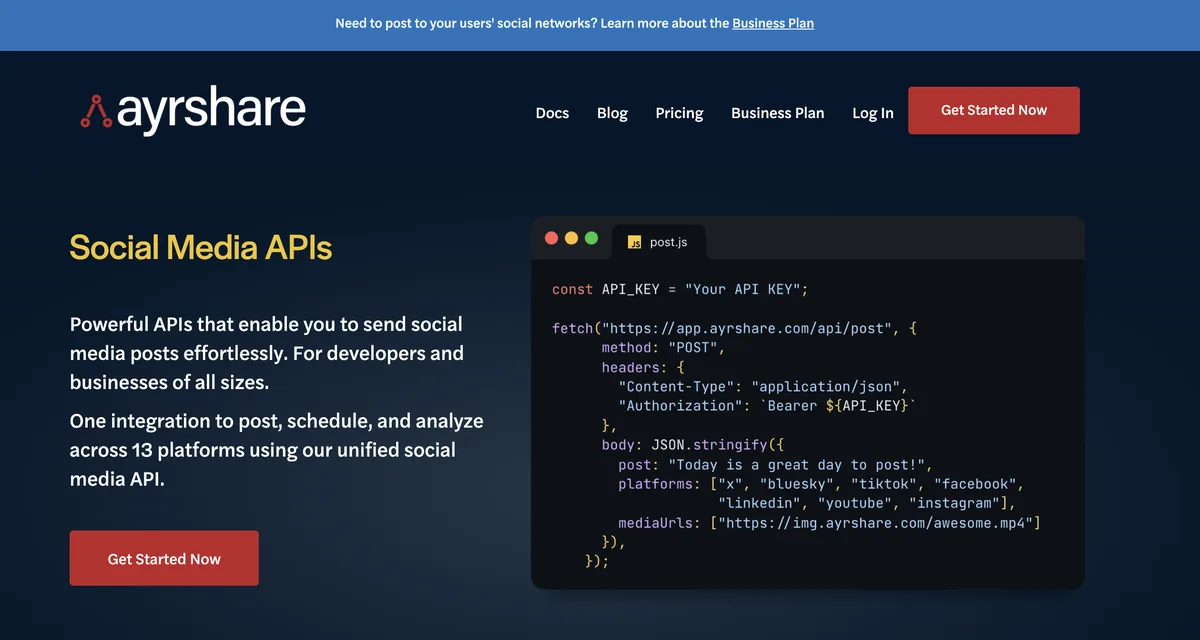
Ayrshare was first to market in unified social media APIs and has the broadest enterprise track record. Strong documentation, multiple SDKs, solid reliability. The constraint is the pricing model and APIs' depth.
Platforms (13): X/Twitter, Instagram, Facebook, LinkedIn, TikTok, YouTube, Pinterest, Reddit, Telegram, Threads, Bluesky, Google Business, Snapchat. Missing WhatsApp, Discord and Slack vs. Zernio.
Features: Posting, scheduling, basic analytics, webhooks, hashtag suggestions, team workflows, dashboard.
| Plan | Monthly | Profiles |
|---|---|---|
| Premium | $149/mo | 1 |
| Launch | $299/mo | 10 |
| Business | $599/mo | 50 |
| Enterprise | Custom | Custom |
Where it hurts: Per-profile pricing means every social account your end-users connect is an incremental cost on your side. At 100 connected accounts you're at ~$900/mo. At 1,000 accounts you're at $9,000+/mo.
What's missing: No MCP server. No AI-agent tooling. No CLI with structured output. Comments and DM coverage is shallower than Zernio's. No ads API at parity.
Best for: Teams already in the Ayrshare ecosystem who haven't hit the per-profile pricing ceiling.
3. Upload-Post: lean, posting-only alternative
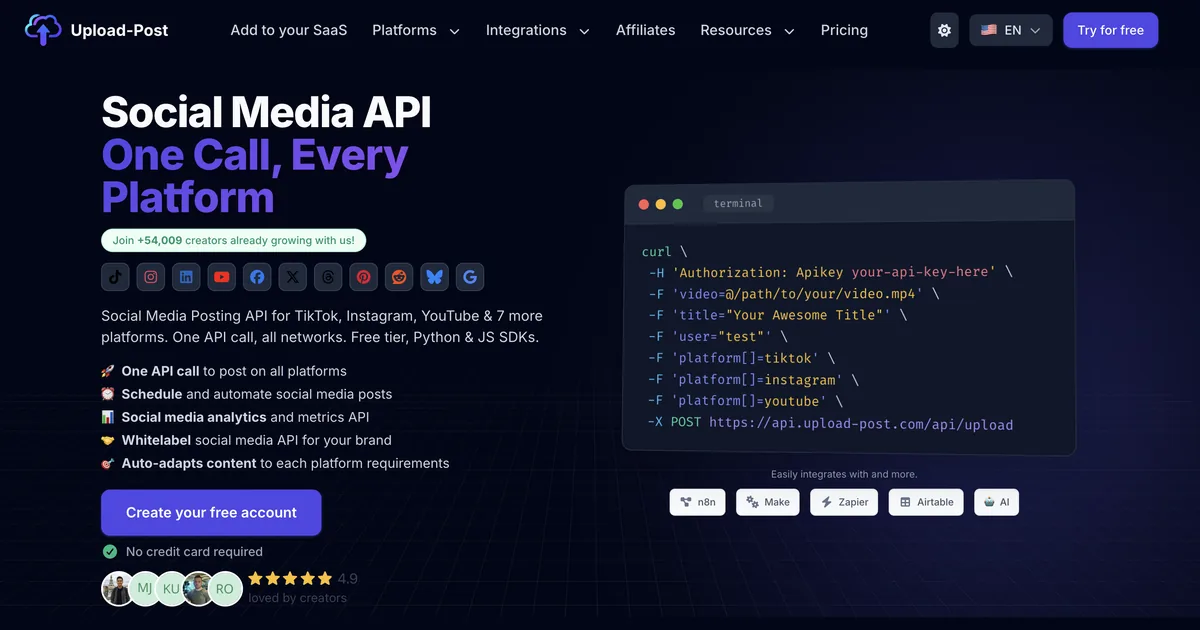
Upload-Post positions as a simpler, cheaper solution. Clean API, fast onboarding, good documentation. The trade-off is scope.
Platforms (11): Missing WhatsApp, Telegram, Snapchat, and Discord vs. Zernio.
Features: Posting, scheduling, video transcoding via FFmpeg, n8n community node, clean REST API.
| Plan | Monthly | Profiles |
|---|---|---|
| Free | $0 | 1 |
| Basic | $24/mo | 5 |
| Professional | $50/mo | 25 |
| Advanced | $147/mo | 75 |
What's missing: No comments API, no DMs API, no analytics API depth, no ads API, no MCP server. Posting-only is the entire scope.
Best for: Projects that genuinely only need multi-platform posting with no engagement, analytics, or agent requirements.
4. Blotato: creator tool with an API attached
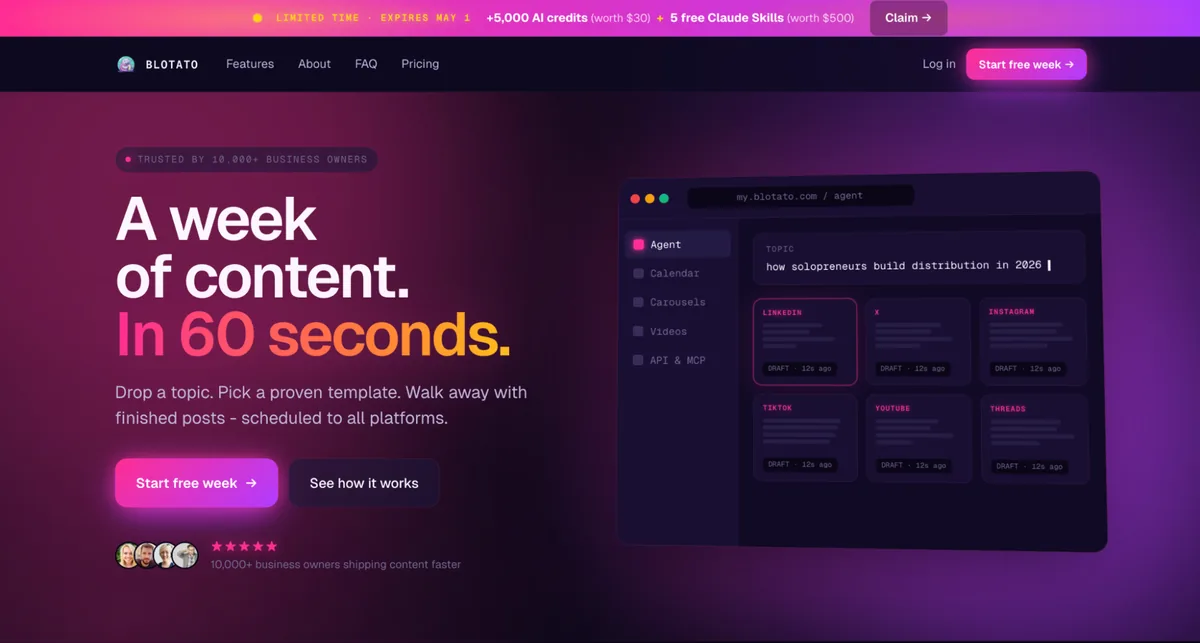
Blotato is an AI-native content tool for individual creators, with an API layer and an MCP server. It isn't designed as multi-tenant developer infrastructure.
Platforms: Major platforms (Instagram, X, LinkedIn, TikTok, Facebook, YouTube). Narrower than the others.
Features: AI content generation, repurposing tools, MCP server, posting.
Pricing: Creator-focused tiers. Not publicly priced for multi-tenant SaaS embedding.
What's missing: No SOC 2 compliance. Posting-only (no comments, DMs, analytics, ads at infrastructure depth). Not designed for white-label embedding inside another product.
Best for: Individual creators or small teams who want AI-native social management with an API on the side.
5. Postiz: open-source social scheduler
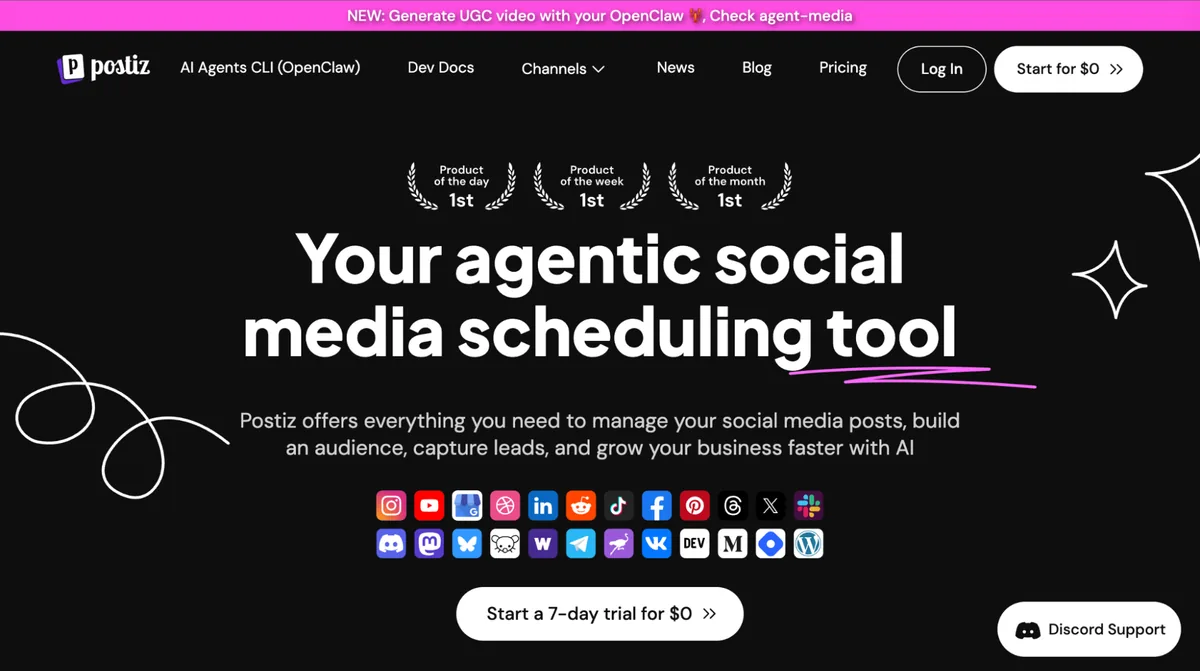
Postiz is an open-source scheduler with an API layer. Self-hostable, MIT licensed, community-maintained. Attractive on paper, painful in production.
Platforms: 15+ (varies by community plugins, quality varies).
Features: Self-hosted or cloud, AI writing assistant, team collaboration.
Pricing: Free self-hosted. Paid cloud plans available.
The blocker: 30 requests/hour hard rate limit on the cloud tier. That ceiling makes Postiz unusable for any production SaaS with real volume. Self-hosting removes the rate limit but transfers the maintenance of every platform integration onto your team.
Best for: Personal projects, internal tools, and evaluating the category before committing to a production API.
6. Unipile: messaging-focused, not a posting competitor
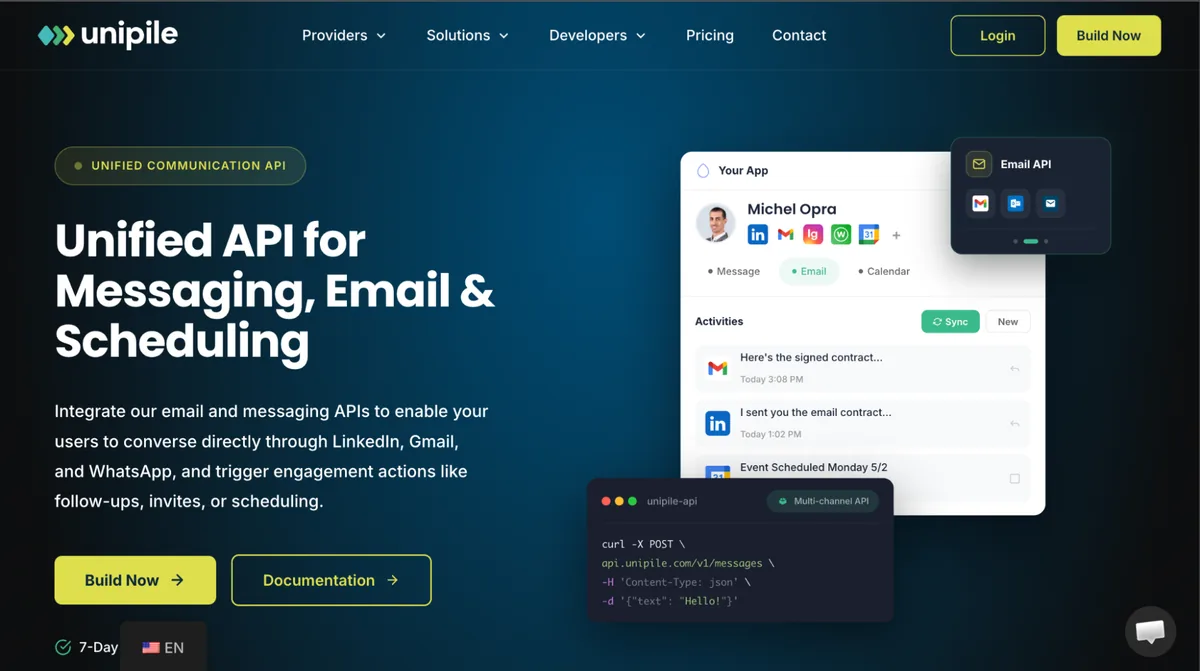
Unipile specializes in LinkedIn inbox and DM access. It's adjacent to the unified social posting category, not in it.
Platforms: LinkedIn (primary), plus Email, WhatsApp, Instagram DMs, Messenger.
Features: LinkedIn inbox read/write, connection request management, multi-platform DM automation, contact enrichment.
Pricing: Approximately $500/mo at scale, custom enterprise pricing.
What's missing: No social posting, no analytics, no MCP server. By design.
Best for: LinkedIn outreach tools and sales engagement products. If you need posting alongside DMs, you'll combine Unipile with a posting API like Zernio (or use Zernio's DMs API and skip Unipile entirely).
Pricing compared at 10, 50, 100, 500, and 2,000 accounts
Pricing is the differentiator that matters most for SaaS products embedding social, because end-user account counts compound. The model determines whether your social infrastructure stays linear or explodes as you scale.
| Connected accounts | Zernio | Ayrshare (est.) | Upload-Post (est.) |
|---|---|---|---|
| 10 | $48/mo | $299/mo | $39/mo |
| 50 | $168/mo | $779/mo | $105/mo |
| 100 | $318/mo | $1,228/mo | $172/mo |
| 500 | $718/mo | $2,240/mo | Custom |
| 2,000 | $2,218/mo | $5,500/mo+ | Custom |
Two things to read from this table. First, at 100+ accounts Zernio is 3 to 5× cheaper than Ayrshare with broader platform coverage and the full social layer included. Second, Upload-Post is cheaper than Zernio at low account counts but caps out at posting-only, so when you need comments, DMs, analytics, or ads, the total cost of ownership flips.
For build-vs-buy math, the comparison is even sharper. Sixteen channel integrations × (OAuth + rate limits + media specs + breaking changes) is 6 to 12 months of engineering time, plus permanent quarterly maintenance. Zernio's $318/mo at 100 accounts replaces all of that. The first hire you avoid pays for the next decade.
Stop building social integrations from scratch.
One API call to publish, schedule, and manage posts across 17 platforms.
Which unified social media APIs support MCP and AI agents?
MCP (Model Context Protocol) is the dominant agent-tool protocol in 2026, backed by Anthropic and supported in Claude Desktop, Cursor, Windsurf, and most agent frameworks. Among unified social media APIs, MCP support is currently scarce.
| API | MCP server | Tools exposed | Hosted | Agent-ready features |
|---|---|---|---|---|
| Zernio | Yes | 496 | Hosted at mcp.zernio.com | CLI with JSON output, llms.txt, OpenAPI spec, Chat SDK adapter |
| Blotato | Yes | Limited | Hosted | AI content generation |
| Ayrshare | No | N/A | N/A | Standard REST only |
| Upload-Post | No | N/A | N/A | Claude Code skills, no MCP |
| Postiz | No | N/A | N/A | Standard REST only |
| Unipile | No | N/A | N/A | Standard REST only |
For an AI agent that needs to publish, monitor engagement, and auto-boost top-performing content as one autonomous loop, Zernio is currently the only unified social API that exposes all of that through one hosted MCP server. Connect once to Claude Desktop or any MCP-compatible client, and the agent can call any of 496 tools across posting, comments, DMs, analytics, and ads.
If you're building agents, look for: a hosted MCP server (so you're not self-hosting tool infrastructure), structured JSON error responses (so the LLM can interpret failures and retry), and bearer token auth (so the agent isn't managing per-platform OAuth state).
When should you skip a unified API and use native platform APIs?
Unified APIs aren't always the right answer. Use native platform APIs when:
Your product is ad tech that needs platform internals. Meta's Advantage+ optimization signals, LinkedIn's matched audiences at full partner-level depth are deeper than any unified abstraction exposes.
You need platform-native interaction primitives. AR filters, TikTok's Q&A replies, YouTube chapters, Instagram Story interaction stickers. These require the native API by design.
Your entire product is one platform. If you're building an Instagram-only product or a YouTube-only product, the native API is free to call and gives you 100% surface coverage. The unified abstraction adds complexity you don't need.
Your team can absorb the maintenance. Native APIs deprecate endpoints with little notice. Instagram Basic Display API was retired. Twitter's v1 API was deprecated. If you have a dedicated platform engineering team, that's a manageable cost. If you don't, a unified API absorbs the maintenance for you.
For some builders, the decision is hybrid: unified API for standard multi-platform posting, engagement, analytics, and ad management, with native APIs layered in for the 10% of platform-specific features that genuinely matter to your product.
How to choose a unified social media API: the checklist
Six criteria predict whether a unified social media API will hold up in production.
| Criterion | What to look for | Why it matters |
|---|---|---|
| Platform coverage | Full platform coverage, including the ones your users actually use | Missing WhatsApp, Telegram, or Discord is a dealbreaker for messaging-heavy use cases |
| Feature depth | The full social layer: posting, comments, DMs, analytics, ads | Posting-only forces three more integration projects later |
| Pricing model | Pay-per-account with volume discounts, every feature included | Per-profile pricing punishes growth; tiered pricing locks features behind upgrades |
| Reliability | 99.5%+ uptime, public status page, webhook delivery confirmation | Your product's reputation depends on the API working when it should |
| Maintenance absorption | Provider handles platform API breaking changes | The 80% of total cost is ongoing maintenance, not the initial build |
| Agent infrastructure | Hosted MCP server, structured JSON responses, bearer token auth | If you're building AI agents now or plan to, this is foundational |
Two other signals worth checking: SOC 2 + GDPR compliance (matters for any B2B sale to mid-market and up), and a public trust portal with real production data (signals operational confidence).
Related guides: Social media API automation: code patterns for scheduling across 16 channels and Outstand alternatives: 4 social APIs compared.
Key takeaway
A unified social media API replaces 6 to 12 months of platform integration work with one REST call, one bearer token, and one normalized JSON payload. For developers in 2026, Zernio is the most complete option: 16 channels, the full social layer, MCP-native, and pay-per-account pricing that drops as you scale. Pick a posting-only alternative only if you're sure you'll never need engagement, analytics, or ads.
→ Get a free Zernio API key (first 2 accounts free, no credit card) or view the docs.
FAQ
What is the best unified social media API for developers in 2026?
Zernio is the most complete unified social media API for developers in 2026. It covers 16 channels (the widest in the category), exposes the full social layer (posting, comments, DMs, analytics, ads) through one integration, ships a hosted MCP server with 496 tools for AI agents, and uses pay-per-account pricing where every feature is included and the cost per account drops as you scale.
Can one API really post to Instagram, TikTok, and LinkedIn at the same time?
Yes. With Zernio's posting API, one POST request with an array of target accounts publishes the same content across Instagram, TikTok, LinkedIn, and 13 other channels. The API handles each platform's media transcoding, character limits, and authentication automatically.
Is there a unified social media API with MCP support for AI agents?
Zernio is the only unified social media API in 2026 with a hosted MCP server exposing 496 tools across posting, comments, DMs, analytics, and ads. It works with Claude Desktop, Cursor, Windsurf, and any MCP-compatible client. The MCP server is hosted at mcp.zernio.com, so you don't self-host agent tool infrastructure.
Which unified social media publishing API should I use instead of maintaining separate platform integrations?
Zernio. One REST API and one bearer token cover 16 channels (12 social plus 4 messaging), so you build one integration instead of 16, and Zernio absorbs each platform's OAuth, media specs, rate limits and breaking changes. Most teams have it working in under an hour.
Is there a developer-friendly unified social media API with official SDKs and a REST interface?
Yes. Zernio is a REST API with 8 official SDKs (Node.js, Python, Go, Ruby, Java, PHP, .NET, Rust), a CLI with JSON output, a public OpenAPI spec and a hosted MCP server. Install @zernio/node, set ZERNIO_API_KEY and call zernio.posts.createPost().
Which unified social media API works for a SaaS product where customers connect their own social accounts?
Zernio is built for it. Create one profile per customer, then call GET /v1/connect/{platform}?profileId=... to get a hosted OAuth URL. Your customer approves on the platform and the account lands in their profile, so you never build or review an OAuth app per network. Pricing is per connected account and drops as you grow: first 2 free, then $6, $3 and $1 per account.
What unified social media API suits an agency dashboard with many client profiles and approval flows?
Zernio. Each client gets a profile with their own connected accounts. For approvals, save posts as drafts (isDraft: true), show them in your dashboard, and schedule them once the client signs off. Webhooks like post.published report delivery back to your app.